|
<BOOK REVIEW>
Published online (May 20, 2024)
Chimpanzee Rights. The Philosophers’ Brief By Kristin Andrews, Gary Comstock, G.K.D. Crozier, Sue Donaldson, Andrew Fenton, Tyler M. John, L. Syd M. Johnson, Robert C. Jones, Will Kymlicka, Letitia Meynell, Nathan Nobis, David Pena-Guzman, Jeff Sebo Routledge, Abingdon, UK 121 pp. 2020 £ 18.99 (paperback) ISBN: 9781138618664, £18.99 (paperback) [Addendum. Alternately, the text of the book is available online at the URL(https://core.ac.uk/display/154425479), free of charge.]
William C. McGrew

School of Psychology and Neuroscience, University of St Andrews, Scotland, UK 
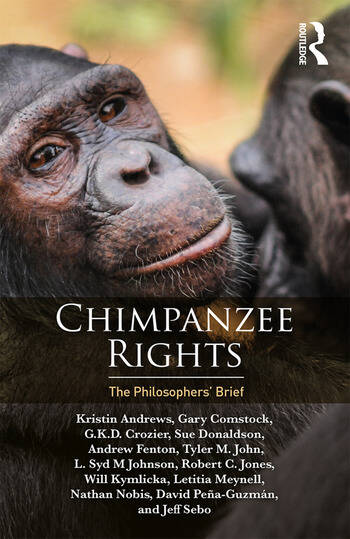
Question: Why should field primatologists be interested in a book about captive chimpanzees, written by a bunch of philosophers? Answer: Because its content focusses on the lives of our nearest living relations, especially those confined in captive squalor, and the philosophers provide valuable help. (This book was published 4 years ago but not reviewed in any primatological journal, so far as I know. It deserves attention.) The book was inspired by the Nonhuman Rights Project (NhRP), whose founder, Steven Wise, provides an Afterword that makes clear the specific task: To seek a writ of habeas corpus on behalf of two incarcerated chimpanzees, Tommy & Kiki. So, the 13 philosophical authors have produced an amicas curia brief to support NhRP’s appeal in court. This book is an expanded version of that brief. (The content necessitates a reviewer’s disclosure: I was not involved in the making of the book, but my first affidavit for NhRP was on behalf of Tommy, done 10 years ago.) Habeas corpus seeks release from present confinement, for which the American courts of law require the establishment of ‘personhood’. To the average human being, personhood applies only to Homo sapiens. Actually, in legal terms, it can be applied to a corporation, ship, river, etc. The legal choice is starkly dichotomous, as all living creatures are legally considered to be either a person or a thing, at least in the USA. Thus, in principle, a nonhuman entity such as an ape can be a person; the challenge is to persuade a judge in court to admit this simple but crucial status. The authors cover five notions of personhood: (1) species membership; (2) social contract (based on obligations and duties); (3) membership in a human community; (4) capacities (see below); (5) sentient being. Each gets detailed scrutiny, and all provide evidence for chimpanzee personhood. Even simple species membership is not so easy: Would Homo neanderthalensis, with whom we humans hybridized, be only a thing? Do only humans have obligations and duties, or do other large-brained vertebrates, e.g. apes, dolphins, also show them? Similarly, membership in a human community in daily life commonly entails companion or farm animals. At least 10 relevant capacities apply to personhood: sentience, emotions, autonomy, self-awareness, sociality, language, rationality, narrative self-constitution, morality, and meaning-making. Some of these attributes are difficult to define operationally, much less demonstrate empirically, but at least some apply to chimpanzees, as we researchers know. Many individual Homo sapiens, such as infants, dementia sufferers, etc. do not show them all but still are granted personhood. Consider the classic experiment done by Hayes and Nissen (1971): Their home-reared chimpanzee ‘daughter’ (Viki) was given a stack of photographs of various species of animals, including humans. Her sorting task was simple: Place each photo in either of two piles, human or nonhuman. Among the photos was one of herself. Viki placed it in the human pile. Surely her choice shows that she was more than a ‘thing’!
In Chapter 5, more than halfway through the book, 47 primatological publications are cited, in order to
back up the preceding arguments. These references are a roll call of prominent chimpologists (Bard, Boesch, de Waal, Goodall, Matsuzawa, Mitani, Nishida, Savage-Rumbaugh, Stanford, Whiten, etc.). The conclusions are
simple and powerful: This is an admirably concise and accessible book. It contains a minimal amount of philosophical jargon. If I still were teaching primatology, I would recommend it to any student with ambitions to pursue a career in our discipline, whether in field, lab or zoo. Thanks to JR Anderson for assistance with this review. REFERENCES Hayes KJ & Nissen C 1971. Higher mental functions of a home-raised chimpanzee. In: Behavior of Nonhuman Primates. Modern Research Trends. Vol. 4. Schrier AM & Stollnitz F (eds). Academic Press, New York, pp. 59–115. Received: 26 September 2023 Accepted: 1 October 2023 Back to Online First |